December Garden Jobs: NZ & Australia
Your December checklist for New Zealand and Australia: what to water, feed and tie up, what to watch for, and what's ready to pick.
Written by Conor, a NZ gardener building Plant Journal
Published
December is when everything happens at once. It's hot, pests wake up, and the first big harvests arrive. A few minutes each week on watering, tying up and checking under leaves saves a lot of crops in January. Here's what to do, by region, and what to watch for.
This week's checklist
- Water deeply two or three times a week, in the morning
- Mulch every bed before the heat really arrives
- Tie up tomatoes and pinch out side shoots
- Check under leaves for aphids, caterpillars and mildew
- Net berries and cherries before the birds find them
- Lift garlic and onions when the leaves brown and flop
Jobs this month
- Water deeply, not daily. Two or three good soaks a week reach the roots. A daily sprinkle mostly evaporates. Pots and seedlings may need water every day.
- Water the soil, not the leaves. Morning is best. Wet leaves overnight invite mildew.
- Mulch everything. 5 to 7 cm of pea straw, compost or bark keeps roots cool and halves your watering. Keep it off the stems.
- Feed for fruit, not leaves. Once tomatoes, capsicum, zucchini and cucumbers flower, switch to a fruit-and-flower feed like tomato food. Too much nitrogen now means leaves, not fruit.
- Stop feeding garlic and onions. They're finishing, and feed only slows them down.
- Tie up tomatoes weekly. Tie the main stem loosely to its stake as it grows. On tall varieties, pinch out side shoots while they're small.
- Thin young fruit. After the natural early drop, thin apples and pears to one or two per cluster, and stone fruit to a hand's width apart. Fewer fruit, bigger fruit.
- Pick often. Zucchini, beans and cucumbers produce more the more you pick.
Your region
Jump to: New Zealand · Temperate Australia · Subtropical Australia · Tropical north
New Zealand
- North (Northland, Auckland, Waikato, Bay of Plenty): humidity brings mildew. Space plants and remove affected leaves early.
- Central (Wellington, Nelson, Marlborough, Hawke's Bay): wind dries soil fast. Mulch heavily and stake firmly.
- South (Canterbury, Otago, Southland): cold nights still happen inland. Keep frost cloth handy in Central Otago, and water well in nor'west winds.
Temperate Australia
Sydney, Melbourne, Adelaide, Hobart, Canberra and Perth.
- Heat is the main stress. Mulch thickly and water early.
- Sydney and the NSW coast are humid as well as hot. Space plants for airflow and watch for mildew after storms.
- Put up 30 to 50% shade cloth over salads and seedlings before a heatwave.
- Perth and Adelaide dry out fastest. Check soil with a finger, not the calendar.
Subtropical Australia
Brisbane, the Gold and Sunshine Coasts, and northern NSW.
- Humidity and storms spread fungal disease fast. Space plants and keep leaves dry.
- Fruit fly is active. Pick as fruit ripens, net or bag it, and clear fallen fruit.
- Grow heat-lovers now. Cool-season crops can wait for autumn.
Tropical north
Darwin, Cairns and Townsville.
- The wet season is starting. Grow on mounds or raised beds so roots don't sit in water.
- Most temperate vegetables are dry-season crops here. Snake beans, okra, sweet potato, kangkong and Ceylon spinach suit the wet.
Problems to watch for
Check under leaves and at the growing tips once or twice a week. Caught early, most of these are easy to deal with.
| Problem | What it looks like | What to do |
|---|---|---|
| Aphids | Tiny green, black or grey insects on new growth; curled, sticky leaves | Squash them or hose them off. Ladybirds and hoverflies eat aphids, so avoid sprays that kill all insects. For bad outbreaks, use an insecticidal soap spray from a garden centre. |
| Caterpillars | Holes in cabbage, broccoli and kale leaves; green caterpillars and droppings underneath | Pick them off by hand, or cover cabbages, broccoli and kale with fine insect netting. For bad infestations, use an organic caterpillar spray (Bt, Bacillus thuringiensis). It only affects caterpillars. |
| Green vegetable bug | Green or black-and-white shield bugs on beans and tomatoes; marked fruit and pods | Early in the morning, while they're sluggish, shake them into a bucket of soapy water. Check under leaves for egg clusters and squash them. |
| Powdery mildew | White powdery coating on zucchini, pumpkin, cucumber and pea leaves | Water the soil, not the leaves, and give plants room for air to move. Remove the worst leaves. Spray early with milk mixed with water (about 1 part milk to 9 parts water), or a mildew spray containing potassium bicarbonate. |
| Blossom end rot | Dark, sunken patch on the bottom of tomatoes, capsicum or zucchini | Water deeply and regularly, and mulch to keep the soil evenly moist. Remove affected fruit. |
| Rust on garlic and onions | Orange spots on leaves that rub off on your fingers | Remove badly affected leaves and keep the leaves dry. If the bulbs are nearly ready, harvest them. Don't grow garlic or onions in the same bed next year. |
| Heat stress and sunscald | Afternoon wilting, scorched leaf edges, pale papery patches on fruit | Water in the morning and mulch well. Put up shade cloth during heatwaves, and don't strip leaves, as they shade the fruit. |
| Tomato-potato psyllid (NZ and parts of Western Australia) | Tiny winged insects and white sugary granules under leaves; yellow, curled new growth | Check the undersides of leaves regularly. Covering potatoes and tomatoes with fine insect netting helps keep them out. Remove badly affected plants. |
| Fruit fly (Australia) | Small puncture marks; maggots in soft, rotting fruit | Pick fruit as it ripens, and net or bag it. Use fruit fly traps. Put fallen fruit in the rubbish rather than the compost. |
| Slugs and snails | Ragged holes and slime trails, worst after rain | Go out at night with a torch and pick them off. Set beer traps (a shallow dish of beer sunk into the soil), or use slug baits made with iron, which are safer around pets than older slug pellets. |
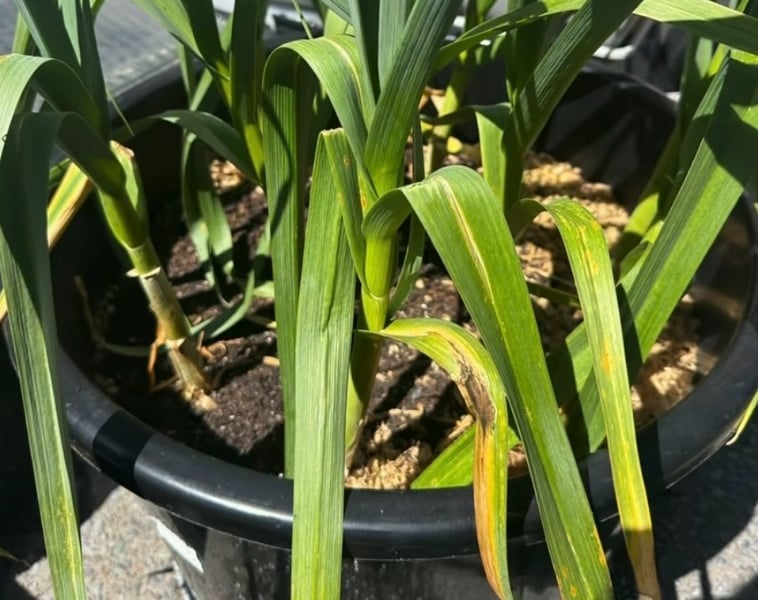
What looks like early rust on my Creole garlic in mid-November: small orange spots on the lower leaves. The upper growth is still strong.
Harvest watch
- Garlic. In NZ, traditionally around the longest day (21 December); in southern Australia, late November into December. Lift when the lower third to half of the leaves are brown. Stop watering a couple of weeks before, then hang it somewhere airy to cure.
- Onions. Ready when the tops flop and yellow. Lift on a dry day and let them dry before storing.
- Early potatoes. About 10 to 14 weeks after planting, often around flowering. Feel around the plant and take a few, leaving the rest to grow.
- Broad beans and peas. Finishing now. Pick the last pods, then cut plants at the base and leave the roots in the soil.
- Strawberries and raspberries. Pick every day or two, in the morning, when fully coloured.
- Zucchini, beans and cucumbers. First picks from mid to late December from spring sowings, earlier in warm areas.
- Tomatoes. Ready now in Brisbane and warm areas. In NZ and temperate Australia, early and cherry types may colour in late December, most from January.
Still worth sowing
Nearly everything in our November sowing guide can still go in. It'll just be ready a few weeks later.
- New Zealand: dwarf beans, zucchini, cucumber, beetroot, carrots, spring onions, basil, and lettuce in shade. Sweetcorn early in the month in warm areas.
- Temperate Australia: beans, zucchini, cucumber, pumpkin, basil, and quick salads in shade.
- Subtropical Australia: snake beans, okra, sweet potato, rosella, capsicum and chilli.
- Tropical north: snake beans, okra, sweet potato, kangkong and Ceylon spinach.
Not sure what you're looking at? Ask Leafy
Leafy is the garden helper inside Plant Journal. When something looks wrong, show it a photo.
- Snap a photo of the plant, in good light and close up.
- Leafy looks at it and gives advice for your plant, where you garden and the time of season.
- Save it to that plant's journal, so you have a record of what happened and what you did.
Here's a real example from my garden. In mid-November I sent Leafy the photo of my Creole garlic above and asked whether it still looked healthy, and whether I should keep giving it tomato fertiliser as the bulbs develop.
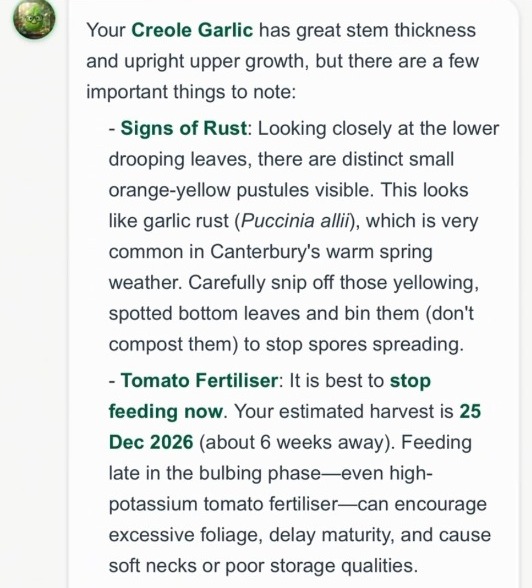
Leafy spotted signs of possible rust on the lower leaves, told me to snip off the spotted leaves and bin them, and said to stop feeding now that the bulbs are forming. It then prepared a journal note (rust, severity 2 of 5), and one tap saved it to my garlic's journal.
Leafy is AI and can make mistakes, so double-check anything important.
Common questions
How often should I water the vegetable garden in summer?
Two or three deep soaks a week. That beats a light sprinkle every day, because the water reaches the roots. Water more in hot, windy weather or sandy soil, and every day for pots. Water in the morning, at the base of the plants, and mulch.
Should I remove the side shoots on my tomatoes?
Yes, on tall (cordon) tomatoes. Pinch out the shoots that grow between a leaf and the main stem while they're small. Bush and most cherry tomatoes don't need it.
What causes blossom end rot?
Uneven watering, usually. The dark, sunken patch on the bottom of tomatoes, capsicum or zucchini happens when calcium doesn't reach the fruit, which is rarely a lack of calcium in the soil. Water deeply and regularly, mulch, and remove affected fruit. New fruit should come through clean.
How do I stop powdery mildew on zucchini and pumpkins?
You can slow it, not always stop it. Water the soil rather than the leaves, give plants room for air to move, remove the worst leaves, and spray early with milk mixed with water, or a mildew spray containing potassium bicarbonate. Plants often keep cropping with some mildew.
Why are my tomato flowers falling off?
Heat or dry soil. Flowers often drop without setting fruit when days are over about 30°C, nights stay very warm, or plants go short of water. Keep watering steady and give afternoon shade in a heatwave. Fruit usually sets again once it cools.
What can I still plant in December?
Plenty. In NZ and southern Australia: beans, zucchini, cucumber, beetroot, carrots and basil, plus lettuce in shade. In Brisbane and the subtropics: heat-lovers like snake beans, okra and sweet potato. See the list by region above.
📷 Snap a photo, get advice for your garden, and keep a record with Leafy.
Get started